
23.2 The Management Agreement
The management agreement creates an agency relationship between the owner and the manager
and spells out the manager’s authority, responsibilities, objectives, compensation, and the term of the agreement.
Property managers are often considered general agents—authorized to perform ongoing tasks of operating the property, and sometimes to enter into contracts.
This agency relationship creates fiduciary duties (like obedience, care, loyalty, accounting, and disclosure).
Components of a Management Agreement (What It Should Include)
The agreement should be in writing and include the basics of a real estate contract, plus management-specific details such as:
- Names of the parties (owner/landlord, manager/agent, tenant if applicable)
- Property description (address, unit, square footage, and other identifying details)
- Term (time period + termination conditions)
- Owner’s purpose/objectives (maximize net income, maximize asset value, minimize expenditures, maintain quality, etc.)
- Owner’s responsibilities (management fee + expenses the manager won’t pay)
- Manager’s authority (hiring/staffing, setting rents, contracting vendors, ordering repairs, spending limits without permission)
- Manager’s responsibilities (marketing, leasing, maintenance, budgeting, reporting, collecting/handling rents)
- Budget (amounts or % of revenue allotted for operations, taxes, insurance, cap-ex, etc.)
- Allocation of costs (which expenses are manager vs. owner)
- Reporting (how often + what reports)
- Compensation (flat fee, % of gross receipts, rental commission, combination, etc.)
- Equal opportunity statement (HUD statement or equivalent for residential property)
Important note: Management fees are not standardized. They must be negotiated between agent and principal
(and should comply with antitrust laws).
Rights, Duties, and Liabilities (Owner vs. Manager)
Landlord/Owner (Typical)
- Right to receive rent and receive premises in specified condition at end of term
- May have right to enter/inspect, examine books, hire/fire staff, choose vendors
- May retain or grant power to set rents, select tenants, and enter contracts
- Duty to pay management fee and other payments detailed in the agreement
- As owner, may be liable for failures to comply with laws (especially environmental and fair housing laws)
Manager/Agent (Typical)
- May have right to hire/fire, enter contracts, and perform routine tasks (depending on authority granted)
- Duties: keep records and report; budget; find/retain/collect from tenants; maintain and secure property; meet owner objectives
- Liabilities: mishandling trust funds; violating fiduciary responsibilities; violating fair housing, credit, and employment laws
Exhibit 23.1 — Abbreviated Sample Management Agreement (Page 1)
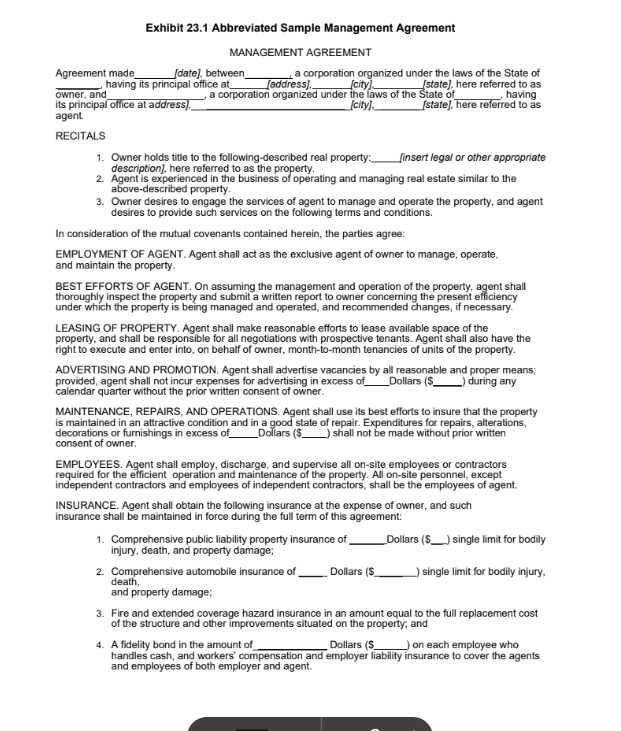
Notice how the agreement spells out authority limits (like spending caps without owner consent) and responsibilities (leasing, advertising, maintenance, insurance).
Exhibit 23.1 — Abbreviated Sample Management Agreement (Continued)
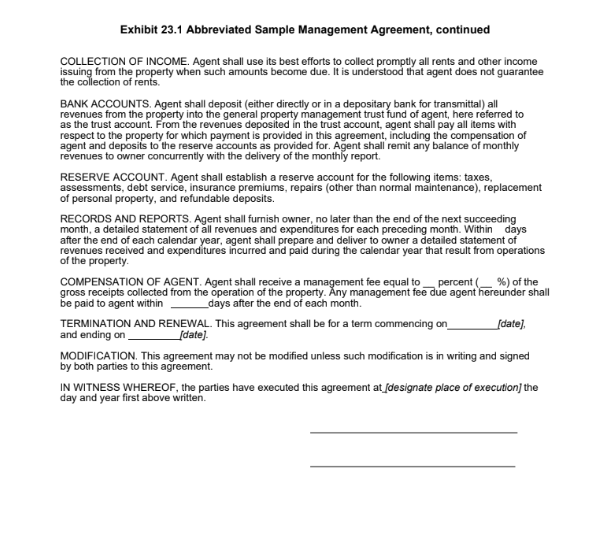
Pay attention to trust accounts, reserve accounts, records/reports, compensation, and termination/modification clauses—these are common exam targets.
Signing On to Manage
Choose the best answer for each question, then select Check Answers.
A management agreement primarily exists to:
Create an agency relationship and define the manager’s authority, duties, and compensation The agreement sets the scope of authority, responsibilities, objectives, compensation, and term—plus it creates fiduciary duties through the agency relationship.
Which item is a common component of a management agreement?
A description of the manager’s authority and spending limits without owner permission Management agreements commonly define what the manager can do (hire, set rents, order repairs) and what requires owner approval (often above a dollar limit).