
15.2 Real Estate Market Dynamics
15.2 Real Estate Market Dynamics
Real estate behaves like other economic products (supply, demand, price, costs, and value), but it also has unique traits: it’s immovable, local, illiquid, and slow to respond. In this topic, you’ll learn how real estate supply and demand are measured, what drives demand (especially employment), how vacancy and absorption signal market shifts, and how the real estate cycle works.
Economic Characteristics of Real Estate
As an economic commodity, real estate is bought, sold, traded, and leased as a product within a real estate market. Like other products and services, it is:
- Subject to the laws of supply and demand
- Governed by the price mechanism
- Influenced by the producer’s costs to bring the product to market
- Influenced by the determinants of value: utility, scarcity, desire, purchasing power
Distinguishing Features (What Makes Real Estate Different)
- Inherent product value: Land is scarce and has inherent utility value.
- Unique appeal: No two parcels are exactly alike (location makes each one different).
- Demand must come to the supply: Real estate can’t be moved to a better market.
- Illiquid: It can’t always be quickly converted to cash; transactions are complex.
- Slow to respond: Construction takes time; markets adjust slowly to shortages or oversupply.
- Local and decentralized: Real estate markets are local and sensitive to local economic swings.
Real Estate Supply and Demand
Supply (How It’s Measured)
In real estate, supply is the amount of property available for sale or lease at any given time. Supply is measured differently depending on property type:
- Residential: dwelling units
- Commercial & industrial: square feet
- Agricultural: acreage
Supply responds to factors such as development costs (especially labor), financing availability, investment returns, a community’s master plan, and government regulation/police powers.
Demand (How It’s Measured)
Demand is the amount of property buyers and tenants wish to acquire by purchase, lease, or trade at any given time. Demand units by property type are:
- Residential: households
- Commercial & industrial: square feet
- Agricultural: acreage
What Drives Demand by Property Type
Demand relates to user concerns—most of which tie back to the value components (desire, utility, scarcity, purchasing power).
Residential users often focus on:
- Quality of life and neighborhood quality
- Convenience and access to services/facilities
- Dwelling amenities vs. household size, lifestyle, and costs
Retail users often focus on:
- Trade area population and income
- Competition level
- Sales volume per square foot
- Consumer spending patterns and growth trends
Office users often focus on:
- Cost of occupancy
- Efficiency/functionality of the space
- Accessibility for employees and suppliers
- Building quality vs. business image and function
Industrial users often focus on:
- Functionality
- Labor pool availability and proximity
- Environmental compliance and zoning
- Health/safety and access to suppliers/distribution channels
Employment: The Engine of Real Estate Demand
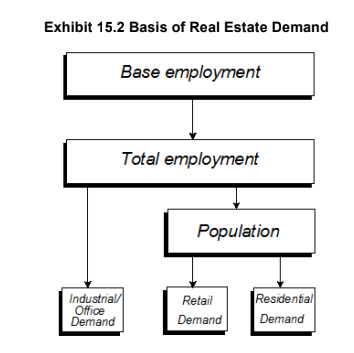
The engine that drives demand for real estate of all types in a market is employment—especially base employment and total employment.
Base employment is the number of people employed in businesses that represent the economic foundation of an area.
Total employment includes base, secondary, and support industries.
As total employment grows, population tends to grow, which increases demand for housing and retail support. Employment also creates purchasing power.
Without employment, demand for real estate can evaporate.
Supply–Demand Cycle: Vacancy, Absorption, and Construction
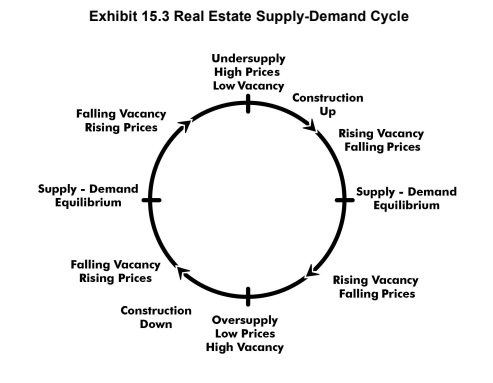
Real estate supply and demand interact to produce price movements. Key indicators include:
- Vacancy: the amount of total inventory that is unoccupied at a given time
- Absorption: the amount of available property that becomes occupied over a period of time
- Construction: the addition of new supply
In an undersupply/high-demand market, vacancy is low and prices are high, which stimulates construction. As new supply is added, vacancy rises and prices fall toward equilibrium. If construction overshoots demand, oversupply occurs, vacancy rises further, prices fall, and construction slows or stops until demand absorbs the excess supply.
Market Influences on Supply and Demand
Many factors can speed up or slow down the real estate cycle. Influences can be local or national, and can come from the public or private sector.
Local market influences include:
- Cost of financing
- Availability of developable land
- Construction costs
- Infrastructure capacity (water, power, roads)
- Government regulation and police powers
- Changes in the economic base
- In- and out-migrations of major employers
National trends can include:
- Changes in money supply
- Inflation
- National economic cycles
Governmental influences can include:
- Local zoning power
- Local control and permitting of new development
- Local taxing power
- Federal influence on interest rates
- Environmental legislation and regulations
Quick Check-Ins (Self-Test)
1) In real estate, which measure is typically used for residential demand?
-
- A. Households
- B. Square feet
- C. Acres
- D. Tons
</ul