
13.1 Function and Organization
13.1 Function and Organization
Brokerage is the business of bringing parties together to complete real estate transactions. In this topic, you’ll focus on what brokers do, how they cooperate, who may legally broker real estate, and how brokerages are organized.
The Core Activity of Brokerage
Effecting a transaction: The core activity of real estate brokerage is procuring a buyer, seller, tenant, or property on behalf of a client for the purpose of completing a transaction.
- Compensation: If successful, the broker receives a commission according to the listing agreement—often a negotiated percentage of the purchase price.
- Broker cooperation (co-brokerage): Many transactions involve a cooperating broker (often called the “selling broker”) who helps locate the buyer/tenant. The listing broker typically splits commission with the co-broker.
- MLS cooperation: A multiple listing service (MLS) is a network of brokers who agree to share and distribute exclusive listings so members can cooperate in marketing and sales.
Critical Brokerage Skills
- Obtaining a client listing
- Marketing a listing
- Facilitating the closing of a transaction
- Managing market information
Brokerage vs. Trading vs. Advisory Services
- Brokerage: acting on behalf of someone else to effect a transaction.
- Trading: buying/selling/leasing for your own account (generally not brokerage).
- Advisory services: consulting for a fee (value estimates, market analysis, property management). Often still requires a license in many states.
Exhibit 13.1 — Common Brokerage Specialties
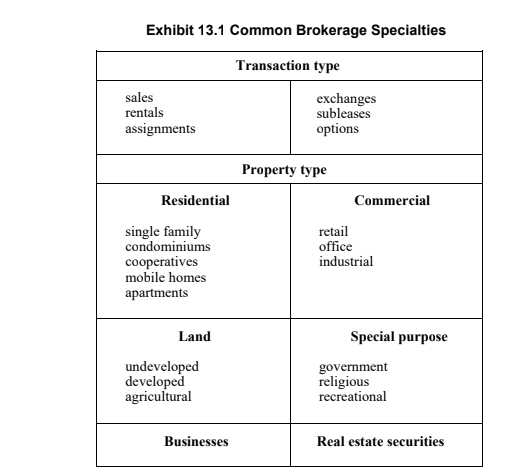
Takeaway: Brokers can specialize by transaction type (sales, rentals, exchanges), property type (residential, commercial, land), or special purpose niches.
Who May Legally Broker Real Estate?
All states impose licensing requirements for anyone who wants to broker real estate. Practicing without a valid license is illegal. Some business entities may broker real estate if properly licensed; others may not.
Exhibit 13.2 — Who May Broker Real Estate
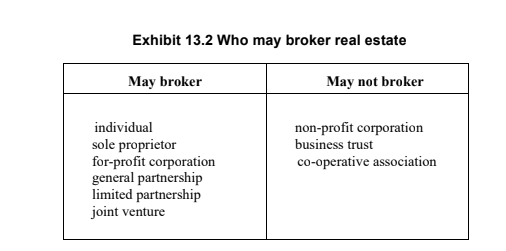
Remember: Many entities can own and sell their own real estate, but that doesn’t automatically mean they can broker real estate for others.
Types of Brokerage Organization
- Independent vs. franchise: independents may join networks; franchises pay fees for brand, training, advertising, referrals, and systems.
- Specialization: by property type (residential/commercial/land), transaction type (rentals/exchanges/business brokerage), or client type (buyer-only, tenant-only, etc.).
Trade Organizations
The National Association of Realtors® (NAR) is a major trade organization. “Realtor®” is a protected term used only by members (often distinguishing member brokers and member sales agents).
Quick Check-Ins (Self-Test)
1) The core activity of real estate brokerage is best described as:
- A. Buying and selling property for your own account
- B. Procuring parties on behalf of a client to complete a transaction
- C. Providing legal advice about contracts
- D. Appraising property for lenders
Show Answer
Correct: B. Brokerage is procuring a buyer/seller/tenant/property on behalf of a client to complete a transaction.
2) Which business entity is generally listed as NOT permitted to broker real estate?
- A. Sole proprietorship
- B. For-profit corporation
- C. Non-profit corporation
- D. General partnership
Show Answer