
21.2 Real Estate Settlement Procedures Act (RESPA)
RESPA is a consumer protection law (enacted in 1974) designed to clarify settlement costs and
eliminate kickbacks and unearned fees that increase the cost of closing. While RESPA is directed mainly at lenders
and settlement companies, licensees should understand the requirements and the disclosures consumers receive.
When RESPA applies
RESPA procedures apply to certain transactions that:
- involve residential property (1–4 family, condos, co-ops),
- involve a first or second mortgage lien, and
- are financed by a federally-related mortgage loan (for example: federally insured lenders, FHA/VA loans, HUD-administered loans, or loans intended for sale to FNMA/FHLMC/GNMA).
RESPA generally does not apply to “otherwise financed” transactions, except certain assumptions where loan terms are modified
or assumption charges exceed $50.
CFPB authority + servicing changes
The CFPB (Consumer Financial Protection Bureau) has rule-making authority under RESPA and supervises/enforces compliance.
Amendments affecting servicing and escrow-related procedures went into effect on January 10, 2014.
TRID (effective October 3, 2015)
The TILA/RESPA Integrated Disclosure Rule (TRID) combined certain disclosure requirements of RESPA and Truth-in-Lending.
It replaced the old Good Faith Estimate and HUD-1 with the Loan Estimate (H-24) and
Closing Disclosure (H-25).
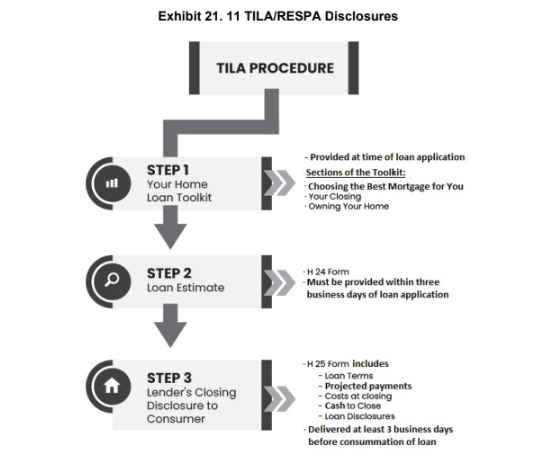
Key required disclosures
- Your Home Loan Toolkit: provided within 3 days of receiving a loan application.
- Loan Estimate (H-24): delivered or mailed no later than the 3rd business day after receiving a loan application.
- Mortgage servicing disclosure: tells the buyer whether the lender will service the loan or transfer servicing, and how complaints can be resolved.
- Closing Disclosure (H-25): must be received by the consumer at least 3 business days before consummation of the loan.
- After settlement: annual escrow statements summarize account inflows/outflows and any shortfalls/overages.
Limits on escrow accounts + referral fee rules
- Escrow limits (Section 10): caps what lenders can require in escrow for taxes, hazard insurance, and other property-related expenses.
- Kickbacks/unearned fees: RESPA prohibits fees for settlement services when no services are actually performed (including referral fees).
- Affiliated business relationships can be permitted if disclosed in writing, the consumer can shop elsewhere, and there are no referral fee exchanges.
1) What is one main purpose of RESPA?
- A. To set minimum down payment requirements
- B. To clarify settlement costs and eliminate kickbacks/unearned fees that increase costs
- C. To require all closings to