
4.6 Cooperatives
Cooperatives
In a cooperative (co-op), you own shares in a non-profit corporation or cooperative association, which then owns the apartment building as its main asset. Your shares entitle you to a proprietary lease to occupy a specific unit. The number of shares you purchase reflects the value of your unit compared to the entire property and determines your share of the property’s expenses.
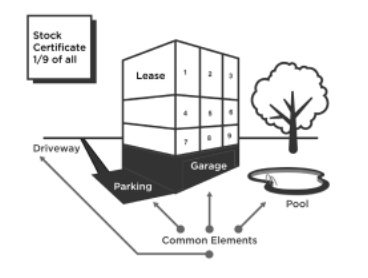
Interests, Rights, and Obligations: The cooperative association holds an undivided real property interest in the entire property. Individual co-op owners do not own real estate; instead, they own personal property in the form of stock and a proprietary lease. The lease has no fixed term and remains effective as long as you own the shares. You pay a monthly assessment for your share of the corporation’s expenses.
If a shareholder fails to pay their assessment, it can jeopardize the entire property, since the corporation’s debts and obligations apply to the whole building. If the corporation cannot pay its bills, creditors may foreclose on the entire property, ending all proprietary leases and bankrupting the corporation.
Transfers: Co-op interests are transferred by assigning both the stock certificate and the lease to the new owner.
Organization and Management: The cooperative association is formed by a developer, which then buys the property. Shareholders elect a board of directors responsible for maintaining and operating the property, as well as controlling use and ownership of units. Voting power is proportional to the number of shares owned.
Co-op Basics
Choose the best answer for each question, then select Check Answers.
What does a cooperative owner actually own?
Co-op owners have personal property: shares and a lease, not real estate.
If a cooperative corporation is foreclosed, what happens to the unit owners?
If the co-op is foreclosed, all proprietary leases end and owners lose their rights to occupy units.