Skip to content
First 20 students get 50% discount.
Login/Register
Call: 205-822-9322
Email: info@alabamarealestateclass.com
myrecoursesmyrecourses
  • Home
  • Courses
  • Live Classes
  • FAQ’s
  • Blog
  • Contact Us
0

Currently Empty: $0.00

Continue shopping

Try For Free
myrecoursesmyrecourses
  • Home
  • Courses
  • Live Classes
  • FAQ’s
  • Blog
  • Contact Us

16.5 The Income Capitalization Approach

  • Home
  • Topic
  • 16.5 The Income Capitalization Approach
Breadcrumb Abstract Shape

16.5 The Income Capitalization Approach

  • 19 Dec, 2025
  • Com 0
  1. 60hr Pre-License Course
  2. Lesson 16 – Appraising & Estimating Market Value
  3. 16.5 The Income Capitalization Approach

16.5 The Income Capitalization Approach

The income capitalization approach estimates value based on a property’s ability to generate income. It’s commonly used for investment properties (like rentals and small multi-family) where buyers focus on income, expenses, and return.

The Core Idea (Income → Value)

In this approach, value is linked to the income the property can produce. Investors typically look at net operating income (NOI) and the rate of return they require.

Key formula:
$$ V = \frac{I}{R} $$

Where V = value, I = NOI (income), and R = capitalization rate.

Steps in the Income Capitalization Approach
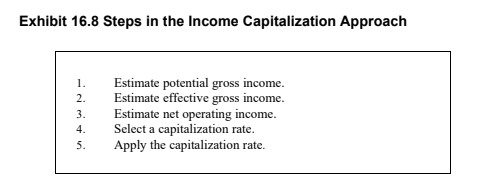
Exhibit 16.8 Steps in the Income Capitalization Approach
Exhibit 16.8: Steps in the Income Capitalization Approach
  1. Estimate potential gross income (what the property could earn at full occupancy).
  2. Estimate effective gross income (after vacancy and collection losses).
  3. Estimate net operating income (NOI) (effective gross income minus operating expenses).
  4. Select a capitalization rate (the investor’s required rate of return).
  5. Apply the capitalization rate to convert income into value.
Important: Operating expenses are the costs to run the property (taxes, insurance, maintenance, management, etc.). They do not include the owner’s mortgage payment.

Income Capitalization Illustration

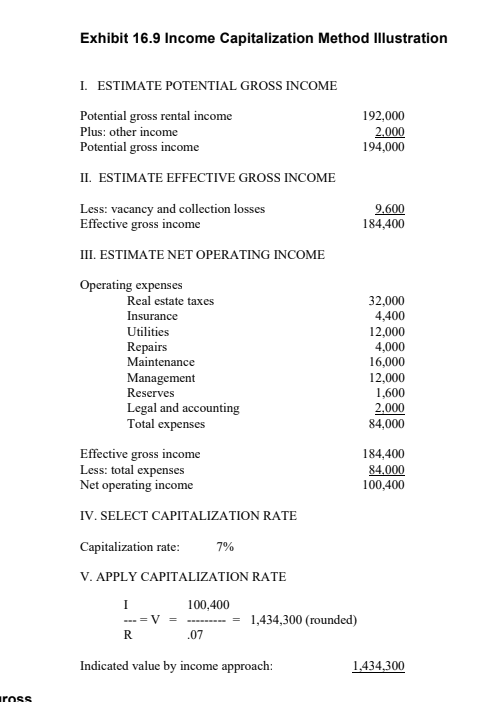
Exhibit 16.9 Income Capitalization Method Illustration
Exhibit 16.9: Income Capitalization Method Illustration
What to notice: The example walks through potential gross income → effective gross income → NOI, then applies a cap rate to estimate value.

GRM and GIM (Shortcut Income Methods)

Two common “multiplier” methods estimate value by comparing sale prices to rent or income:

  • GRM (Gross Rent Multiplier): uses monthly rent.
  • GIM (Gross Income Multiplier): uses annual gross income.
Big picture: Multipliers are quick estimates and do not subtract operating expenses (so they’re less detailed than NOI/cap rate analysis).

GRM Illustration

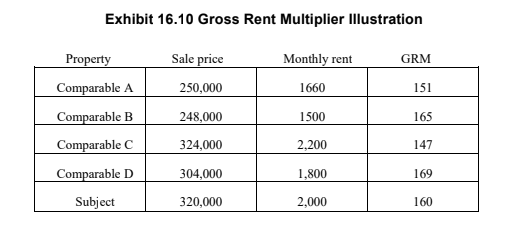
Exhibit 16.10 Gross Rent Multiplier Illustration
Exhibit 16.10: Gross Rent Multiplier (GRM) Illustration

GIM Illustration

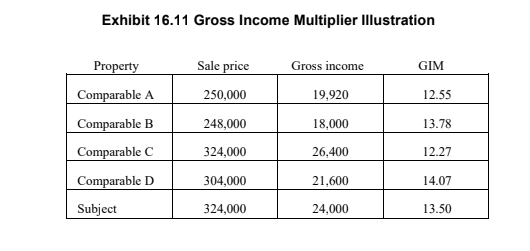
Exhibit 16.11 Gross Income Multiplier Illustration
Exhibit 16.11: Gross Income Multiplier (GIM) Illustration

Quick Check-Ins (Self-Test)

1) In direct capitalization, what does NOI represent?

  • A. Gross income before vacancy and expenses
  • B. Income after vacancy losses and operating expenses
  • C. The owner’s mortgage payment
  • D. The listing price
Show Answer

Correct: B. NOI is the income remaining after vacancy/collection losses and operating expenses are subtracted.

2) Which statement is true about GRM/GIM methods?

  • A. They subtract operating expenses to find NOI
  • B. They are quick estimates based on rent or gross income
  • C. They are only used for vacant land
  • D. They require a full URAR form
Show Answer

Correct: B. GRM/GIM are multiplier shortcuts based on rent or gross income (not NOI).

Previous Previous Topic
Next Next Topic
Back to Course

Search

Latest Post

Thumb
Crafting Effective Learning Guide Line
15 Nov, 2023
Thumb
Exploring Learning Landscapes in Academic
14 Nov, 2023
Thumb
Voices from the Learning Education Hub
13 Nov, 2023

Categories

  • Uncategorized (5)

Tags

2 Child Education Classroom Design Development Future Higher Study
© 2026 - EduBlink. All Rights Reserved. Proudly powered by DevsBlink
myrecoursesmyrecourses
Sign inSign up

Sign in

Don’t have an account? Sign up
Lost your password?

Sign up

Already have an account? Sign in