
18.5 Investment Analysis of a Residence
18.5 Investment Analysis of a Residence
A primary residence is typically a non-income property, meaning it doesn’t produce rental income (unless a portion is used for business or rent). In this topic, you’ll learn how to evaluate a residence as an investment using appreciation, tax benefits (like mortgage interest), and how gain on sale is calculated for tax purposes.
What “Investment Analysis” Means Here
Investment analysis examines the economic performance of an investment by looking at costs, income (if any), taxation, appreciation, and overall return.
Since a primary residence usually does not generate income, its investment value typically comes from:
appreciation, leverage, and certain tax benefits.
Appreciation (Increase in Value Over Time)
Appreciation is the increase in value of an asset over time. A simple estimate of total appreciation is:
Current value − Original price = Total appreciation
To express appreciation as a percentage of the original price:
Total appreciation ÷ Original price = % appreciation
To estimate annual appreciation (simple average), divide the percent appreciated by the number of years owned.
Deductibles (Common Tax Benefit for a Residence)
The primary tax benefit for many homeowners is the annual deduction for mortgage interest (subject to current IRS rules and limitations).
The portion of the mortgage payment that goes to principal is not deductible.
Also, depreciation is not allowed for a non-income property.
Tax Liability: Gain on Sale (How the IRS Defines “Gain”)
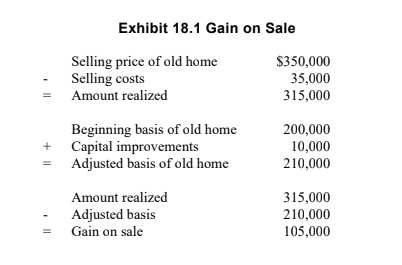
The IRS generally defines gain on the sale of a home as:
amount realized (net proceeds) minus the home’s adjusted basis.
Sale price − Costs of sale = Amount realized
Adjusted basis starts with the beginning basis (often the purchase price plus certain settlement costs) and is then adjusted:
Beginning basis + Capital improvements − Exclusions/credits/amounts received = Adjusted basis
Finally, the basic gain formula is:
Amount realized − Adjusted basis = Gain on sale
Gains Tax Exclusion (Primary Residence)
Tax law provides a gain exclusion of up to $250,000 for an individual taxpayer and $500,000 for married taxpayers filing jointly (as presented in the text),
generally available every two years if the taxpayer meets the ownership and use requirements.
- Owned the property for at least two years during the five years preceding the sale;
- Used the property as a principal residence for a total of two years during that five-year period;
- Waited two years since last using the exclusion for any sale.
Running the Numbers: Residential
Choose the best answer for each question, then select Check Answers.
The “amount realized” from the sale of a home is generally:
Amount realized is net proceeds: sale price minus costs of sale.
Which item would typically increase a homeowner’s adjusted basis?
Capital improvements increase the adjusted basis of the home.