
17.3 Qualifying for a Mortgage Loan
17.3 Qualifying for a Mortgage Loan
To qualify for a mortgage loan, borrowers must meet lender standards for income, debt, cash reserves, net worth, and credit. This topic covers ECOA protections, the key qualification ratios, and the loan constant concept used to estimate payments and borrowing power.
Equal Credit Opportunity Act (ECOA)
The Equal Credit Opportunity Act (ECOA) requires lenders to evaluate applicants based on their own income and credit, unless the applicant asks to include another person’s information. ECOA also prohibits discrimination in lending decisions.
Qualifying the Borrower (Ability to Repay)
Lenders assess whether the borrower can reasonably repay the loan. Underwriting commonly considers income/assets, employment status, credit history, the proposed mortgage payment, other debts, and the borrower’s debt-to-income ratio (DTI).
Income Ratio and Debt Ratio
Many lenders use two key ratios to estimate affordability:
Limits the percent of gross monthly income that can be spent on housing costs (often PITI and related housing expenses).
Considers housing costs plus other monthly debt obligations (credit cards, car loans, etc.).
Loan Constant (Payment Shortcut)
A loan constant is a pre-calculated number that relates the monthly principal-and-interest payment to a $1,000 loan amount for a specific interest rate and term. It helps estimate:
- the monthly PI payment for a given loan amount, rate, and term
- the loan amount a borrower can afford based on a monthly PI budget
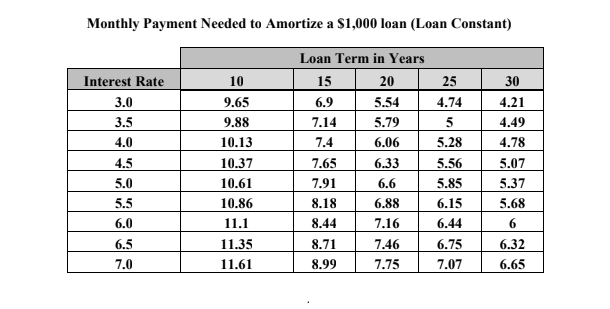
(Loan amount ÷ 1,000) × Constant = Monthly PI payment
(Monthly PI payment ÷ Constant) × 1,000 = Loan amount
Other Qualification Factors
- Cash qualification: lender verifies funds for the down payment (gift letters may be required for gifts).
- Net worth: shows reserves and ability to sustain payments during disruptions (like job loss).
- Credit evaluation: lender reviews credit report/score and public record items (judgments, bankruptcies, foreclosures, etc.).
- Loan commitment: written pledge to lend under specific terms (firm, lock-in, conditional, take-out).
Does the Borrower Qualify?
Choose the best answer for each question, then select Check Answers.
The loan constant is used to:
Loan constants help estimate payments or loan amount for a given interest rate and term.
ECOA is primarily designed to:
ECOA prohibits discrimination in lending and requires fair evaluation of applicants.