
22.1 Risk Management Strategies
Big idea: Risk is the chance of losing something. In real estate, risk shows up constantly because licensees make lots of judgment calls every day.
Risk management is a structured way to handle uncertainty by anticipating problems and planning ahead—so risk is reduced to an acceptable level.
Risk has two dimensions:
- Probability (how likely it is to happen)
- Exposure (how big the consequences could be—money or non-money)
Risk Management Strategies (4)
Four well-established strategies for managing risk are:
- Avoidance (elimination): refraining from an activity that carries risk
- Reduction (mitigation, sharing): lowering the chance or severity of loss
- Transference (outsourcing, insuring): shifting risk to another party (often by contract or insurance)
- Retention (acceptance and budgeting): taking on the risk and responsibility (self-insurance)
Real-world note: Complete avoidance is almost impossible in real estate. Even “safe” choices (like hiring only experienced agents)
don’t eliminate risk—because people can misunderstand the law or break it on purpose. At best, you reduce risk… not erase it.
Exhibit 22.1 — Risk Management Strategies and Procedures
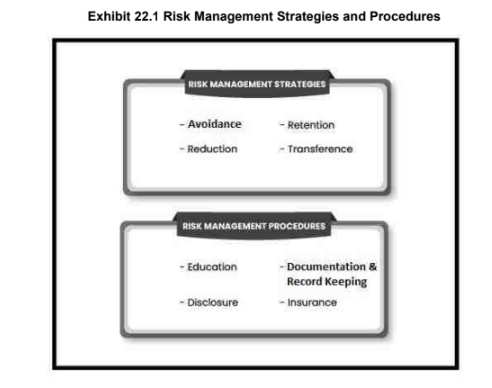
Use this exhibit as a quick “map”: strategies describe how you handle risk, and procedures describe the daily habits that prevent problems.
Risk Management Procedures (Most Practical in Real Estate)
In real estate practice, the most practical strategies tend to be reduction and transference.
Procedures often focus on:
- Education
- Disclosure
- Documentation and record keeping
- Insurance
Think of it like this: Education helps you avoid mistakes, disclosure reduces misunderstandings, documentation proves what happened,
and insurance helps transfer certain losses when mistakes still occur.
Playing It Safe
Choose the best answer for each question, then select Check Answers.
Which risk management strategy is most like “self-insurance”?
Retention Retention means you enter the activity knowing the risk and accept full responsibility for the consequences—basically self-insurance.
Risk has two dimensions. Which pair matches the text?
Probability of occurrence and extent of exposure Risk is measured by how likely something is to happen and how serious the consequences could be (money or non-money).