
21.4 Computing Prorations
21.4 Computing Prorations (12-month/30-day Method and 365-day Method)
Proration divides responsibility for certain expenses or income between buyer and seller based on time. The proration method
used may be stated in the sale contract; if not, it follows local custom.
Customarily, the seller owns the property up to and including the day of closing unless the contract states otherwise.
That means the closing day belongs to the seller when computing prorations.
Exhibit 21.7 — Who Gets Charged
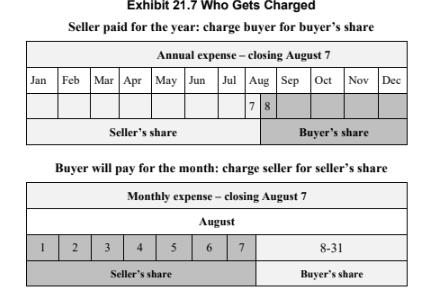
Quick rule: if one party paid (or received) money that covers time after closing, the other party reimburses them through a debit/credit entry.
12-month / 30-day method (360-day year)
This method uses a 30-day month and a 360-day year to create an average daily rate. It’s commonly used for prorating
mortgage interest, and may be used for taxes depending on local practice.
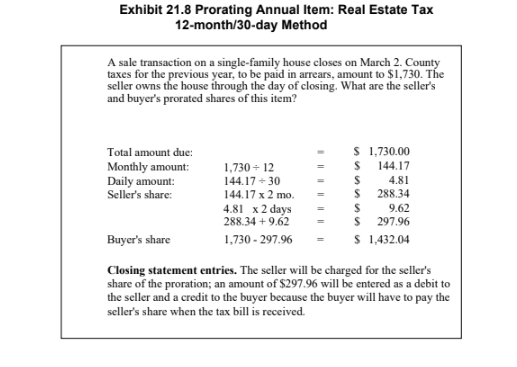
Annual items (12/30) — steps
- Identify the total amount to be prorated.
- Divide by 12 to get an average monthly amount.
- Divide the monthly amount by 30 to get an average daily amount.
- Compute the seller’s share (months + days through closing day).
- Buyer’s share = total − seller’s share.
Exhibit 21.8 — Prorating Annual Item: Real Estate Tax (12-month/30-day Method)
<