Skip to content
First 20 students get 50% discount.
Login/Register
Call: 205-822-9322
Email: info@alabamarealestateclass.com
myrecoursesmyrecourses
  • Home
  • Courses
  • Live Classes
  • FAQ’s
  • Blog
  • Contact Us
0

Currently Empty: $0.00

Continue shopping

Try For Free
myrecoursesmyrecourses
  • Home
  • Courses
  • Live Classes
  • FAQ’s
  • Blog
  • Contact Us

16.4 The Cost Approach

  • Home
  • Topic
  • 16.4 The Cost Approach
Breadcrumb Abstract Shape

16.4 The Cost Approach

  • 19 Dec, 2025
  • Com 0
  1. 60hr Pre-License Course
  2. Lesson 16 – Appraising & Estimating Market Value
  3. 16.4 The Cost Approach

16.4 The Cost Approach

The cost approach estimates value by adding the land value to the current cost to build the improvements, then subtracting depreciation. It’s especially useful for newer properties and special-purpose buildings where comparable sales are limited.

The Core Idea (Cost New Minus Depreciation)

The cost approach is based on the idea that a buyer won’t pay more for a property than it would cost to buy the land and build a similar improvement—minus depreciation.

In simple terms:

Estimated Value = Land Value + (Cost New − Depreciation)

Reproduction Cost vs. Replacement Cost

  • Reproduction cost: cost to build an exact replica using the same materials and design.
  • Replacement cost: cost to build a property with equal utility using modern materials and standards.
Exam-friendly takeaway: Replacement cost is used more often in typical residential appraisal because it reflects modern building methods.

Depreciation (What Gets Subtracted)

Depreciation is any loss in value from the cost new of the improvements. In appraisal, depreciation is commonly grouped into:

  • Physical deterioration (wear and tear)
  • Functional obsolescence (layout/design/features that are outdated or undesirable)
  • External obsolescence (negative influences outside the property, like traffic, nearby nuisances, or market conditions)
Helpful distinction: Physical and functional issues may be curable or incurable. External obsolescence is typically considered incurable by the property owner.

Steps in the Cost Approach

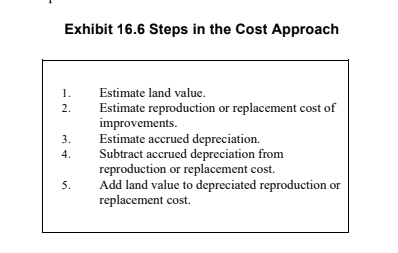
Exhibit 16.6 Steps in the Cost Approach
Exhibit 16.6: Steps in the Cost Approach
  1. Estimate land value.
  2. Estimate reproduction or replacement cost of improvements.
  3. Estimate accrued depreciation.
  4. Subtract depreciation from the reproduction/replacement cost.
  5. Add land value to the depreciated cost of improvements.

Cost Approach Illustration
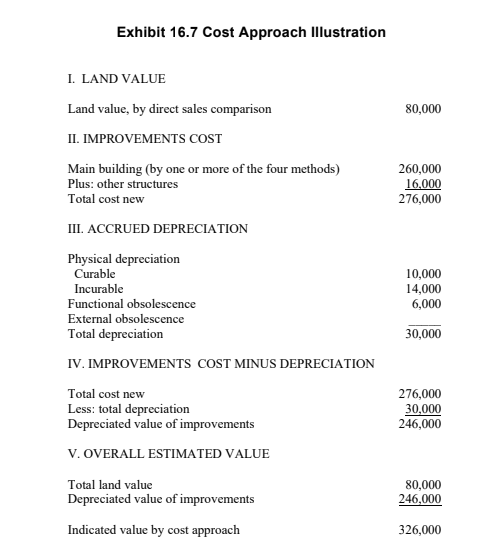
Exhibit 16.7 Cost Approach Illustration
Exhibit 16.7: Cost Approach Illustration
What to notice: The illustration shows land value + cost new, then subtracts depreciation to reach an indicated value by the cost approach.

Quick Check-Ins (Self-Test)

1) The cost approach is MOST useful when:

  • A. The property is brand new or nearly new
  • B. There are hundreds of identical recent sales
  • C. The property is valued only by rent
  • D. The buyer is paying cash
Show Answer

Correct: A. The cost approach is especially helpful for newer properties and special-purpose buildings.

2) Which type of depreciation is caused by factors outside the property?

  • A. Physical deterioration
  • B. Functional obsolescence
  • C. External obsolescence
  • D. Replacement cost
Show Answer

Correct: C. External obsolescence comes from outside influences (location/market/environmental factors).

Previous Previous Topic
Next Next Topic
Back to Course

Search

Latest Post

Thumb
Crafting Effective Learning Guide Line
15 Nov, 2023
Thumb
Exploring Learning Landscapes in Academic
14 Nov, 2023
Thumb
Voices from the Learning Education Hub
13 Nov, 2023

Categories

  • Uncategorized (5)

Tags

2 Child Education Classroom Design Development Future Higher Study
© 2026 - EduBlink. All Rights Reserved. Proudly powered by DevsBlink
myrecoursesmyrecourses
Sign inSign up

Sign in

Don’t have an account? Sign up
Lost your password?

Sign up

Already have an account? Sign in