
16.1 Real Estate Value
16.1 Real Estate Value
Real estate value is the present monetary worth of the benefits that come from owning real property. In this topic, you’ll learn the main benefits of ownership, the economic principles that influence value, and common types of value used in real estate.
What Is Real Estate Value?
Real estate value is the present monetary worth of benefits arising from the ownership of real estate.
The primary benefits that contribute to real estate value include:
- Income: rent or other income streams from the property (including rights such as air, surface, or subsurface).
- Appreciation: an increase in market value over time, often tied to rising sale prices in the market area.
- Use: the benefits tied to how the property can be used (residential, commercial, agricultural, recreational, etc.).
- Tax benefits: depending on tax law, benefits may include capital gain treatment, depreciation, deferrals, or tax losses.
Foundations of Real Estate Value (Key Economic Principles)
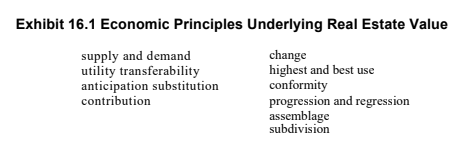
A number of economic forces interact in the marketplace to influence real estate value. These principles show up constantly in appraisal logic and exam questions.
Quick, student-friendly meanings
- Supply & demand: scarcity tends to push values up; surplus tends to push values down.
- Utility: a property must have a use people will pay for (function alone isn’t enough).
- Transferability: the easier it is to transfer clear title/rights, the more valuable it tends to be.
- Anticipation: buyers pay based on expected future benefits (like rent or resale).
- Substitution: buyers won’t pay more than the cost of an equally desirable substitute.
- Contribution: an improvement is worth what it adds to market value (not what it costs).
- Change: markets and properties change over time—value must reflect that.
- Highest and best use: the legally permissible, physically possible, financially feasible use that is maximally productive.
- Conformity: value is maximized when a property fits its surroundings.
- Progression/regression: nearby values influence each other (higher neighbors can pull value up; lower can pull it down).
- Assemblage/subdivision: combining parcels can create plottage; dividing land can increase total value.
Types of Real Estate Value
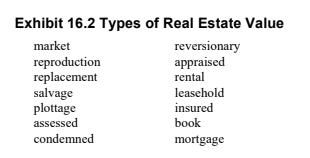
The purpose of an appraisal affects the type of value being estimated. Here are common value types you’ll see in real estate practice:
A few high-frequency definitions
- Market value: estimated price a property should sell for at a particular time (most common appraisal goal).
- Reproduction value: cost to build an exact duplicate of improvements at today’s costs.
- Replacement value: cost to build a functional equivalent using modern materials/methods.
- Assessed value: value set by a taxing authority for ad valorem taxes.
- Plottage value: extra value created by combining parcels (assemblage).
- Rental value: estimated rent a property can command for a specific period.
- Mortgage value: value of the property as collateral for a loan.
What Makes It Valuable?
Choose the best answer for each question, then select Check Answers.
Which principle is being applied when a buyer refuses to pay more for a home than the cost of a similar home nearby?
Substitution means a buyer won’t pay more than the cost of an equally desirable substitute.
Adding a bathroom increases a home’s market value by $15,000, even though it cost $20,000 to build. Which principle does this illustrate?
Contribution is what the market