
13.2 The Broker-Salesperson Relationship
13.2 The Broker–Salesperson Relationship
Only a broker can employ a licensed salesperson. Salespersons work in the broker’s name, follow the broker’s policies, and must be supervised—regardless of whether they are employees or independent contractors.
Legal Relationships
Key rule: A salesperson is authorized to represent the broker and carry out duties the broker legitimately delegates. The salesperson does not independently represent the public outside the broker’s supervision.
What a salesperson may do (on the broker’s behalf)
- Offer properties for sale or lease
- Procure buyers and tenants
- Negotiate transaction terms (within the broker’s delegated authority)
- Conduct brokerage activities in the broker’s name
What a salesperson may NOT do
- Bind a client to a contract
- Receive compensation directly from a client
- Accept a listing or deposit that is not in the name of the broker
- Work for more than one employing broker (in most states)
Salesperson’s Employment Status
Independent Contractor (IC)
- Broker can require results, but has limited control over how work is performed.
- IC is responsible for income and Social Security taxes (broker doesn’t withhold).
- Broker generally cannot provide employee benefits (health insurance, pension, etc.).
Employee
- Broker has greater control (methods, hours, meetings, policies).
- Broker withholds taxes and pays unemployment compensation tax.
- Employee may receive benefits offered to staff.
Obligations and Responsibilities
Salesperson’s typical commitments to the broker
- Work diligently to sell the broker’s listings and procure new listings
- Promote the broker’s reputation and follow office policies
- Fulfill fiduciary duties owed to clients as a subagent (as applicable)
- Maintain required insurance and professional/ethical standards
Broker’s typical commitments to the salesperson
- Provide access to listings, market data, and office support
- Provide promised training and uphold compensation agreements
- Maintain ethical standards and follow the employment agreement
Agent Compensation (Commission Splits)
Commission is commonly split by “sides” (listing side and selling side). An agent may earn from one side or both, depending on who procures the listing and who procures the buyer/tenant.
Exhibit 13.3 — Calculating Commissions
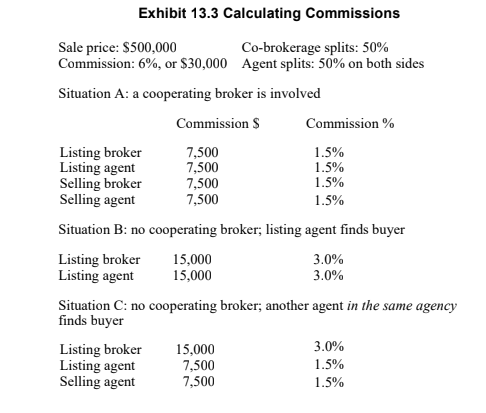
Takeaway: Co-brokerage splits and agent splits can significantly change who receives what portion of the total commission.
Broker and Salesperson
Choose the best answer for each question, then select Check Answers.
Which statement is true about a licensed salesperson?
A salesperson is authorized to represent the broker and perform delegated duties under supervision.
In most states, a salesperson may NOT:
Compensation must flow through the employing broker, not directly from the client.