
8.1 Real Estate Planning
Real Estate Planning
While the Constitution guarantees individual ownership of real estate, it does not guarantee uncontrolled use, sale, or development. Unregulated land use can harm property values and the environment, so land use controls are necessary to protect community interests, safety, and welfare.
Goals of Land Use Control:
- Preserve property values
- Promote the highest and best use of property
- Balance individual property rights with the public good
- Control growth within infrastructure capabilities
- Incorporate community consensus into planning activities
Both individual and community interests must be considered. Unregulated use can harm neighboring properties and the community, while government actions can impact private property values.
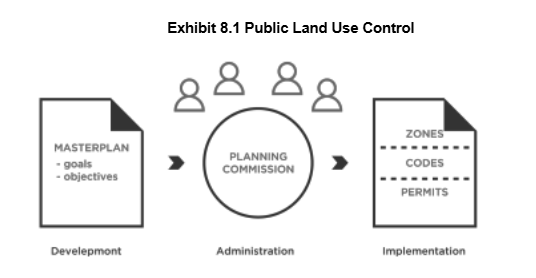
How Land Use Goals Are Achieved:
- Development of a master plan for the jurisdiction
- Administration of the plan by a planning commission
- Implementation through zoning, codes, permits, and other public controls
Private entities (like subdivision associations) may also impose additional land use standards via deed restrictions.
The Master Plan: Public land use planning uses a long-term land use or master plan, required by state law in many areas. The plan must meet local needs and conform to state, regional, and federal laws. State agencies often have approval power over local plans.
Planning Objectives:
- Amount of growth: Limits set to match infrastructure and forecasted trends
- Growth patterns: Type, location, density, and impact of development
- Accommodating demand: Plans for new or expanded services, facilities, and infrastructure
Plan Development: Planning involves analyzing population, demographics, economics, land use, facilities, and traffic patterns to set policies that guide future growth.
Planning Management: County and municipal departments implement, enforce, and administer the master plan. A planning commission, usually appointed by government officials, oversees these activities, approves site and subdivision plans, building permits, and rules on zoning issues.
Planning the Community
Choose the best answer for each question, then select Check Answers.
What is a primary purpose of public land use control?
Land use controls aim to balance individual and community interests.
What is the role of a planning commission?
The planning commission manages the master plan and enforces land use regulations.