
5.2 Easements
Easements
An easement is an interest in real property that gives the holder the right to use portions of another’s property in a specific way. Easements may apply to the surface, subsurface, or airspace, and must be clearly defined.
- Easements always involve the owner of the land and another party—one cannot have an easement over their own property.
- Easements may be affirmative (allowing use, like a right-of-way) or negative (prohibiting use, like blocking a view).
Types of Easements:
- Easement Appurtenant: Attaches to the land and benefits a neighboring property (dominant tenement). The property burdened by the easement is the servient tenement. Easements transfer automatically with the property.
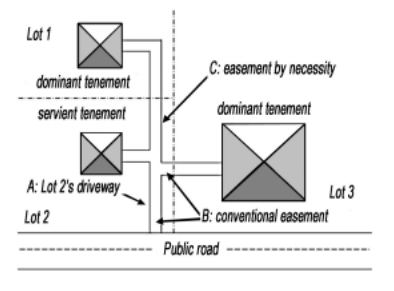
- Easement by Necessity: Court-ordered access to prevent landlocked property.
- Party Wall Easement: Agreements for shared structures (walls, fences, driveways).
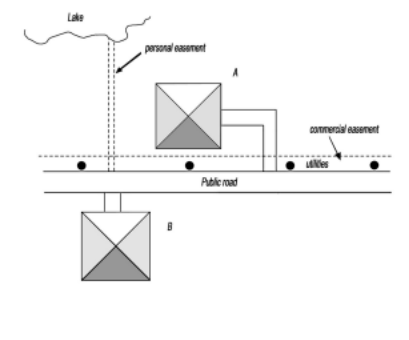
- Easement in Gross: A personal or commercial right to use another’s land (not tied to ownership of another parcel). Personal easements in gross are for an individual’s lifetime, while commercial easements in gross (e.g., utilities) can be assigned or transferred.
Creation and Termination:
- Created by voluntary grant, necessity, prescription, or eminent domain.
- Terminated by release, merger, abandonment, condemnation, change of purpose, destruction, or non-use (for prescriptive easements).
Topic 5.2 Check-In
The Right to Cross
Choose the best answer for each question, then select Check Answers.
What is the property that benefits from an easement appurtenant called?
The dominant tenement is the property that benefits from the easement.
Which of the following is true about a commercial easement in gross?
Commercial easements in gross are not tied to ownership of land and can be transferred.
🔒 Mark Complete unlocks when every answer is correct.